
AF-S 14-24mm f/2.8G IF-ED, AF-S DX 18-55mm f/3.5-5.6G VR, AF-S 18-200mm f/3.5-5.6G DX VR IF-ED, Tamron 70-300mm f/4-5.6 AF Di LD Macro, AF-S 50mm f/1.4G, 300-800 f/5.6 APO EX DG HSM
You may be wondering what’s all those stuff mean! Don’t worry! Today I am back with an article, aimed to help you understand stuff related to lens, in simple and easy words 😛

A small note :
Photography is only a hobby for me. I will try to explain a few things I have been learning since the last months. Feel free to share your own experience. This blog post is aimed to newbies only… You may want to read a previous article in which I introduced photography in a few words…
What is a lens?
The wikipedia definition goes as follows :
“A photographic lens (also known as objective lens or photographic objective) is an optical lens or assembly of lenses used in conjunction with a camera body and mechanism to make images of objects either on photographic film or on other media capable of storing an image chemically or electronically.”
You don’t need to learn this by heart. You can skip the definition, it won’t be of much use to you right now.
What you need to know…
You have surely noticed the “14-24mm” or “18-55mm” or “70-300mm” in the first line of this post. Well, these are known as the focal range of the lens.
Before going any further, you need to understand the following, I need to mention that for the sake of simplicity, I won’t be taking the 35mm or crop factors into consideration. I need to document myself more in depth before being able to explain these parts to you. But you should note that these are widely used terms in photography.
Let’s see a few images, all at the same location (from La Citadelle, Port Louis) but shot at different focal length.

Typically, the optical zoom of a lens is calculated as follows :
Optical zoom = maximum focal length / minimum focal length
Example of lens :
- AF-S DX 18-55mm f/3.5-5.6G VR
Zoom = 55/18 = approx 3.0x - Tamron 70-300mm f/4-5.6 AF Di LD Macro
Zoom = 300/70 = approx 4.2x
Zoom, focus, aren’t they the same thing?
There is a difference between the 2 words.
You normally zoom to have a larger image of what you are shooting. This is done by extending the focal length of the lens by turning the zoom ring on the lens to make it longer. Beware, we are talking about optical zoom here, not digital zoom. In short, digital zoom is a processing done by the camera to enlarge the picture as it is. At the end, you may end up with a picture, full of small squares(pixels).
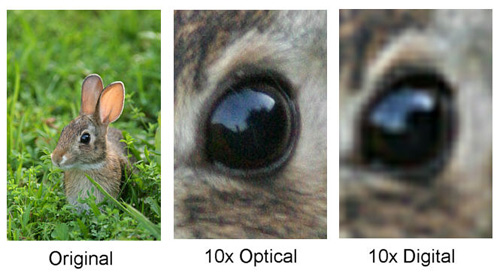
[image from http://photo.net/equipment/digital/basics/ ]
On the other hand, focusing allows you to select a point or a region of what you will be shooting. It is a bit difficult to explain it in words. The following images will help you to get a better idea :

“3.5-5.6G”, what do they really stand for?
Good question…
That’s the maximum aperture that can be obtained using this lens. The aperture is a measurement to denote how large is the opening of the lens, hence the amount of light that can enter.

For this specific example ( AF-S DX 18-55mm f/3.5-5.6G VR), a maximum aperture of 3.5 can be obtained at the lowest focal lenght, i.e. 18mm and a maximum aperture of 5.6 at the end, 55mm.
Understanding aperture can be a bit confusing. Let’s see how…

[aperture diagram from here ]
A large aperture number (ex. f11) refers to a SMALL opening of the lens (allowing little light in) and a small aperture number (ex f3.5) refers to a LARGE opening (allowing more light in).
Only one aperture marking?

Some lenses have only 1 aperture, take the following lens as example : AF–S NIKKOR 24–70mm f/2.8G ED.
Well, this lens have the same minimum aperture of 2.8G over the whole focal length. Please note that these lenses are generally much more expensive.
Only one focal length(mm)?

No, they did not forget to print the other ‘mm’ value. In fact, these type of lenses are called prime lenses. They offer only a fixed focal length, for example 35mm or 50mm. You can’t zoom with this lens because of the fixed focal length. However the image is of much better quality and they focus more quickly, even in low light conditions.
Example : AF-S 50mm f/1.4G
Because of the larger aperture(smaller number), this lens will be able collect more light than a lens with an aperture range of 3.5-5.6, hence produce better images even in low light.
Built in motor into lens / body motor
Once again, a simple explanation : A motor is necessary to move the lens elements in order to vary the focal length, hence the zoom. As written above, the motor can either be in the body of the camera itself or into the lens. We often talk about auto focus motor lens in the second case.
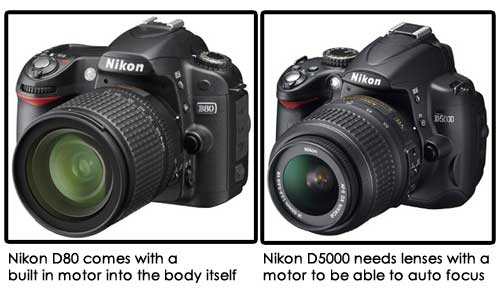
Nikon examples
- without a motor in the body : D40, D60, D3000 and the D5000.
- with a motor in the body : D80, D90
A lens for a D80 will work on a D5000 but due to that lack of a motor in the body (of the D5000), the auto focus will not work. Hence, the person needs to manually use the focus ring when taking pictures. Older lenses did not have any motors, hence the D80 has a wider choice of lenses for use, while the D5000 is restricted to newer lenses only.
Please bear in mind that a lens designed for one make of cameras cannot be used on another make. We are here talking about the mount, which basically allows a lens to fit into a specific camera. However, there exists adapters which can be used.
I hope that this article helped you to have a better understanding of lenses used in digital photography and some of the terms used in this field.
Feel free to ask any questions and also, don’t hesitate to share your experience. And of course, please leave any comments if I made errors in the article above.
Other images from


nice article…
camera people you can check these for full review of your next purchase:
http://steves-digicams.com/
http://www.cameralabs.com/
LikeLike
Nice ..
Question on my mind .. Is The Nikon D90 Better Than D5000, D80, D3000 And D60 ??
LikeLike
@Le_Voyageur :
“The Camera does not make good photographs”. I wonder why I always like to mention CarrotMadman06’s quote!
Note these points :
Price difference…
D90 has a built in motor, not D5000.
D90 officially replaces the D80, which was released a few yrs back.
D40 and D60 are now replaced by D3000 and D5000. These models were released quite a few years back, once again.
D90 has an LCD screen on the top, which may be useful to the photographer.
Sensor-wise, if I can say so, D5000 and D90 share the same sensor…
Last, but not the least, everything (feature and every pixel) has a price…
LikeLike
Nice post. The first two lines were scary though 😛
Got to learn a little bit about camera lenses 🙂
LikeLike
This is an interesting post and straight to the point. Good reference points.
LikeLike
Yashvin, you are missing a detail, some cameras are not full frame, so when you calculate the zoom, you need to multiply it by the crop factor. So my 100-400mm lens would have: 400/100 = 4 * 1.6 (1.6 for canon)
that 1.6 is called the focal multiplier
which gives me 6.4x But as you see, its not much of a zoom, but remember its starting zoom position is at the 100mm. So we tend to disregard the zoom in terms of x on an slr camera and only refer tothe maximum reach, which is the second number, and multiply that number by the crop factor, to get an estimate of what a 35mm would require to capture an image at that same depth.
🙂
hope I didnt confuse you lol
LikeLike
@Kunal : Ki tone faire kunal!
Dimoune cpv al zette lecorps tout la avec sa explication la 😛
ABC pas encore apprane, to pu faire zotte ouvert encyclopedie tout 😛
Thanks toujours 😛
LikeLike
lol!!!! 😀
LikeLike
A nice, well written post. I hate it when people try to explain focal length/ aperture settings without diagrammatic/photographic aids, so it’s great that you haven’t done that have included images.
You used the 70-300mm f/4-5.6 AF Di LD Macro in your article. Some readers might ask what do the bits after,”AF Di LD Macro”, mean? And is it important.
Macro, Telephoto, Wide-angle lens are quite different 🙂
Hope you don’t mind the constructive criticism! 😀
LikeLike
You made a mistake with your explanation of the f/2.8 lenses. It’s not they have a single aperture, but that they can open to that aperture over the entire focal length range. They are called fast lenses (as compared to the normal zoom lenses whose maximum apertures vary depending on the focal length).
Eddy.
LikeLike
@Eddy : Thanks for reading and correcting that point 🙂
@Nav : Of course not. I am always open for suggestions and comments.
hmm. Don’t worry, I planned to write about this specific new lens of mine because I noticed that there are only a few articles about this lens, with some real pictures. I will use the same post to introduce these terms you mentioned 🙂
Keep tuned to yashvinblogs!
LikeLike
the best Telephoto lens that i have used on an SLR is the Canon EF 70-200 F/2.8 lens. Best image quality ever.*~`
LikeLike
Hi,
Very informative indeed. I now have a better understanding about lens especially when talking about 18-55 or 70-300mm. The image is clearer in my mind.
Thanks
yash
LikeLike
well Yashvin that’s a helpful article about lenses, that really make it easy for me, actually i’m using a canon 450d with a lens 18-55mm but want to get a telephoto lens, since you guys know about lenses more than i do then could anyone advice me which telephoto lens could be suitable for me?
many thanks
LikeLike
Hi @vyky!
Whenever u need to purchase something new in photography, there are 2 questions that I believe you need to ask yourself :
1. What you will do with it?
2. Budget
So, here you are looking for a telephoto lens.
However, it might be a bit difficult (and inappropriate) for a Nikon user (me) to advise you for a Canon lens 😛
Since your budget will probably be limited, I can ask you to do the following :
Go on ebay, do an advance search with the following criterias : “Canon”, “< your budget", filter the results to get the lens results.
You might then choose the type of lens and google for the affordable lenses in that budget. 🙂
That might be a first step while looking for your lens.
Any Canon user are welcomed to give more precise advice.
Good luck!
LikeLike
Very well written Yashvin! I have myself a Canon 7D and a Canon T3i SLRs.
LikeLike
In layman’s term. That’s an awesome article. I have a 5D and a T3i SLR myself!
LikeLike
very informative and definitely better explained than many websites. Just ordered a camcorder on ebay. Wish me luck.
LikeLike
printed on my nikon p520 camera lens is
1.3 – 5.9
4.3 – 180mm
ED, VR.
what exactly these means and how to use?
LikeLike
Hello.
Easiest first – VR = Vibration Reduction. As the name suggests, it limits the vibration caused to give you better results when you are operating the equipement. While some lenses have a switch to allow you to disable it, most ones have it built-in by default, which is actually a good thing.
43-180mm is the focal length. To put it simple, it gives an indication of how far or close you can zoom using the camera buttons or directly from ur lens, depending on your equipment
f/3 – 5.9 : This one gives you an indication of your f-stop or aperture opening. The smaller the number, the more wide the lens opens to allow more light to enter the camera’s sensor. And with more light at a time, you can get clearer pictures and better shots in low light conditions.
And finally, E.D stands for extra low dispersion elements. Quite technical thing in regards to the way the lens was built. Do not worry about it at this point of time.
LikeLike