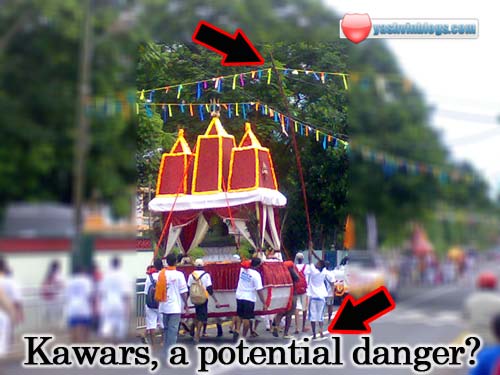

I find that some people exaggerate too much while building their “holy” kanwars for the Mahashivratree festival.
You have surely noticed that many kanwars are much larger than standard cars and much heigher than electrical cables on the streets.
I won’t deny, they are indeed beautiful, but have you ever thought about the danger of carrying these things on the roads?
Did god mentioned somewhere that you achieve your “pilgrimage” only when you carry the biggest kanwars to Grand Bassin?

Picture Courtesy of Deepa.
Some common practices
Have a look at the following picture:

Remarks:
- The kawar is much higher than the road deco “pavillon triangles” (someone can tell me the english word please?)
- The guys have not only took the whole lane for then, but even part of the other lane, thus forcing the bus to halt and wait for them to pass.
- Long rods are used to hold cables and everything else, which come into their way.
This scene is very common, you can surely see this everywhere.
A small story…
Some 2 or 3 years back, I had set “la pagaille” into my neighbourhood, lol!
1 or 2 weeks had already elapsed since Mahashivratree but a group of persons left their big kanwars on the side of the road, just like that…
For me, it was an unacceptable thing because
- Those guys were never in any prayers, but just for this one, you can see them present playing the main roles.
- The kanwars were left there, abandoned while being a danger for the road users, that is ME!
In broad daylight, I went there and took some posters with me, in which I wrote:
“Depotoire ici” (Dumping area here) or things like that.
lol, I came back home, and a few hours later, the area was cleaned! haha!
Believe me, since then, no one dares to leave their kawars abandoned!
Setting standards for kawars?
With the increasing number of huge kanwars on the road, the risk of accidents and the probability of having traffic jams are on the rise.
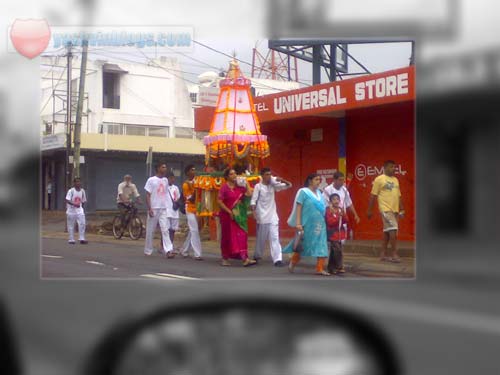
Do you think its time for the authorities to set some standards for the size of kanwars?
Just imagine, what if all the kanwars were small?
- No need to block a whole lane for the pilgrims and the kanwars.
- No huge traffic jams.
- Everyone walking in “file indienne”.
- Decreased risk of accidents
Loads of people would actually be frustrated, specially those “religious” organisations.
Naturally, the government will never go for such standards, since this will definitely make most(?) the hindous hate them!
Very bad for political parties when the majority of Mauritians are hindous.
The economics of Mahashivratree
Before ending, a few humourous advices (sometimes true indeed) sent by $pl@$#:
[UPDATE : As one of the readers(Roushdat) mentioned below, this article seems to be written by a Mauritian Hindu Priest.
Can someone please send me his name if you are aware of this? Thanks.]
Some extracts :
- Do not throw money in Ganga Talao on grounds that wishes will be fulfilled. […] Instead put in donation boxes. […]Â e. g 50,000 (devotees) x Rs 10 = Rs 500,000 thrown in water each year (average estimate).
- […] all offerings (prasad) should be taken away, otherwises it would decay and cause pollution/environmental degradation. Cleanliness is next to Godliness.
An offering costs about Rs 150/200 per family, […] Offerings should be moderate, not excessive. E. g 400,000 (devotees) x Rs 100 = Rs 40 million wasted each year (average estimate). - Disposal of offerings involves high scavenging (labour) and transport costs. […]
We buy, we carry, we pray and offer in the name of Lord Shiva and leave it deliberately […] ?
Is it religiously correct to classify these offerings as waste ? We are failing in our religious duties. - The passenger capacity of one bus is about 65 passengers which is equivaient to that of 25 cars. […] This would result in substantial savings in fuel and intangible costs.
- A pilgrimage is always based on discipline and sacrifice. It is not a fun walk. It’s an inner-seeking religious walk.
Maha Shivratree should be performed in a spirit of sacrifice, otherwise it would be adharmic (religiously incorrect).
[…]
“Shiva” means change.
It destroys.
It’s high time to change our excessive attitudes and adopt a sustainable mindset in this religious realm. […]
But I ask myself, when will we change?


diffamation. lol.
” You made my day haha! Do whatever you want. ” you said it Yashvin
du momment ki to dans ene lieu public, et ki pas in viol to private space\intimiter pas capave faire narnien.
@rikesh au contraire. au lieu to passe incognito, aster to foto pu wadir ene trainer la poudre lor internet. Facebook, Forum, MSN, My Space, Twitter, etc
LikeLike
@yurit0s:
The best thing is that this guy cannot get the online photo removed by any means…
LikeLike
Yashvin, for once, i agree with u, when u r targeting sth related to my religion! this guy has got a big problem. I do encourage him to go ahead with his pathetic plea. Every year the authorities keep on repeating loud and clear that such kanwars r not to be made n carried on the way to gbassin.
I duno when you lots would understand this simple, piece of fact. Enormous kanwars have always been public danger, n against the numerous warnings of even the various Hindu leaders.
THumbs up!
LikeLike
@yashvinawootar:disqus hi, would you like to have some pics of ganga talao 2012. if so how can i post it to you ??
LikeLike
Hello.
Mail them over to me : yashvin[@]awootar[dot].com
Thanks.
LikeLike
@yashvinawootar:disqus just sent you the photos, do let me know if you received it ??
LikeLike
Yes, thanks.
LikeLike
?Yashvin: Mah? ?iva R?tr? Demystified. Ofet zordi mo pu share ar zot 1 veriter ki boku dimune pa coner.
Mah? ?iva R?tr?, literally means ‘The great night of ?iva’; it is the
night whereby full attendance of the ?ivali?ga coronation (a.k.a
abhi?ek) ceremony is to be attended (at any place, in temple of your
hometown or in any temple located within grand bassin or even at home if
you have one ?ivali?ga established here) and on this day people should
be chanting the pañc?k?ar? (lit. 5 syllabes) mantra – nama? ?iv?ya –
throughout their whole day as well as offering their obeisances in the
form of prayers to those revered figures (God). If you fail to do so,
then one can say you did not participated for this event.
Carrying kanwal (big or small) and/or carrying additional paraphernalia
is only a man-created myth to fulfill their fanciful desires. This myth
is more especially visible in our modern youths who are very excited to
embark on similar journeys like the pilgrimage towards G.Bassin to only
serve this in showcasing themselves to the girls, flaunting that as if
they are uprooting some big stuffs that no one ever did that before and
will never be able to do such even after 5 generations! when fact is –
all those are fake and unnecessary. Some even carry a jambe along and
sing throughout the road, they’d shout as if they’ve been returning
from one party and now going to another one. Interestingly, there is no
mention about carrying big and/adorned Kanwal or about any other thing
that people do on this day or to evene go to G. Bassin in the scriptures
(?iva Pur??a) especially on their way to any temple of ?iva. It’s
required for devotees (not commoners) to go visit any ?iva temple
especially because of the coronation ceremony, which qualifies as a
must. Some people prefer to go to one temple located at G.bassin and
with time it became a fanciful tradition. And now, it got upgraded as a
merrying walk akin to like walking towards a party. If you
are spiritually inclined, then you ought be sticking to the rules as
established by ancient tenets on this day – i.e. to attending the ?iva
abhi?ek (at night) as well as to focus yourself entirely onto chanting –
nama? ?iv?ya – the whole day. That said, should you fail to attend
the 4 sessions coronation ceremony then it means you did not take part
of that event unless you are something like bedridden then it’s
plausible. Otherwise just by abstaining meat on this day, or by walking
to Grand Bassin is purely fictitious to the event of Mah? ?iva R?tr?. True Story.
LikeLike
I used to love it, thinking it was a ”tradition”… but 6 yrs I am in India.. I’ve never seen one….. It’s just a competition there….
LikeLike